| End of an Era in Loveland Politics |


Loveland - November 13, 2011
While recent commentaries have focused on the increasing partisanship of Loveland City Council races, little attention
has been paid to the real milestone of the recent swearing-in of Loveland’s newest city council members. Joining the
ranks of Loveland’s City Council are Chauncey Taylor, Ralph Trenary, John Fogle and Phil Farley.
Conspicuously absent from the newly elected candidates is any member of Loveland’s 'Old Guard' that governed
Loveland for the better part of a decade.
Failed candidate and departing Councilwoman Carol Johnson warned the community of the partisan ties of now a
majority of Loveland’s City Council in a November 3, letter to the editor. While perhaps it is historic that Democrats
enjoy 5 out of 9 votes on Loveland’s City Council (Cecil Gutierrez, Cat McEwen, Joan Shaffer, Ralph Trenary
and Phil Farley), we believe Mayor Gutierrez’s ability to herd those 5 Demo-cats into a common direction is in doubt.
Behind the scenes, Mayor Gutierrez is working feverishly to shuffle committee assignments of council members and
choreograph the political impression and outcome of future council meetings. Gutierrez is anxious to begin building his
own legacy with this new majority by making Loveland a public transit model city. Alternative energy buses, a rail link
for commuters to Denver and more bike lanes and trails across our community are the building blocks Gutierrez
believes will define him in history as our ‘transit mayor.’
Unfortunately, Gutierrez appears willing to use all of the same old dirty tricks of secret meeting votes and counting
individual votes before the “public” meetings; an activity he found so objectionable in his adversaries who ran the ‘Old
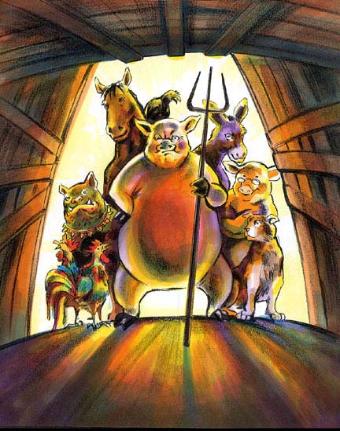
Guard.’ So blinded by his new goals, Gutierrez now runs the risk of creating a legacy akin to that of the pigs in George
Orwell’s Animal Farm.
What Happened To The “Old Guard?”
Gone today is the tight group of council fellow travelers often called the ‘Old Guard’ who governed Loveland with an
iron fist. Former Mayor Pro Tem Larry Heckel was replaced on the council by Ralph Trenary who now sits in
Heckel’s old seat representing Loveland’s Ward 4. Heckel served on the council for years as a leader of what has
been pejoratively called not just the “Old Guard” but “Good Ole’ Boys” and “McWhinneyCrat” councilors. Former
councilman Dave Clark failed this year in his attempt to regain a seat on Loveland’s City Council due, in part, to
baggage he carried as a former member of the ‘Old Guard.’
Spurred into local politics beginning in the mid-1990’s, the group was self-described simply as “pro-business” and
fancied themselves the defenders of growth in a political environment they feared “Boulder liberals” would impose a no-
growth agenda on Loveland. Nearly every member of this group from former reluctant Loveland Mayor Larry Walsh
to Gene Pielin relied on new construction and an increasing population to sustain their businesses and families. They
pitched a popular message in a community where nearly 30% of residents depended either directly or indirectly on the
construction industry for household income.
Somewhere along the way, however, the self described “pro-business” faction not only helped themselves but helped
unpopular special interests apparently believing in the end it is money and power alone that can save you politically.
Any pretence of supporting all businesses in Loveland was forgotten in favor of a system where winners and loser could
be selected in city hall.
The Old Guard helped California developer McWhinney dig deep into Loveland taxpayer pockets when developing
land the brothers inherited or had contracts to purchase along I-25. Ultimately, they sowed the seeds of mistrust and
suspicion that would eventually give rise to the newly identified “partisan” Democrat faction on council. The Old Guard
splintered and dispersed even more in recent years as their efforts to subsidize local businesses in a slowing economy
through ill advised “jobs” subsidies backfired.
A Poor Role Model
Ten years ago this month, Don Marostica was elected to represent Loveland’s Ward 1 on city council when Kathy
Gilliland was elected Mayor and Larry Heckel lost his first bid to serve on council to Larry Walsh. Gilliland, a
Democrat, and Marostica, a registered Republican at that time, joined together in their attempts to raise taxes, subsidize
favored developers while also launching Loveland head first into even more government subsidized housing. Later,
Gilliland would be replaced by Walsh and Heckel would find his way onto the city council where his proximity to the
Loveland Housing Authorty landed him lucrative opportunities to develop Harvest Gold.
At its height in 2004, the “pro-business” council approved a 25 year tax avoidance scheme for McWhinney
developments in Loveland setting the stage for decades of inequitable tax burdens for Loveland's less politically
connected taxpayers. Instead of attracting all new businesses to Loveland, McWhinney began poaching existing
companies into its Centerra project thus creating blight across west Loveland; the type the tax schemes are supposed
to remedy. The unpopular 2004 MFA (Master Financing Agreement) with McWhinney marked a low point in public
opinion and interest in local politics.
Loveland’s 2005 municipal election was perhaps the least competitive in its modern history due to undue influence by
the “Old Guard “on potential candidates. Anyone considering a run were approached and discourage if an anointed
candidate had already been found. Punitive politics that sought to economically punish local dissenters allowed
advanced selection of appropriate candidates to walk onto Loveland’s City Council unopposed. 2005 was a
remarkable election year. David Clark, Ronald Weaks and Glenn Rousey all ran unopposed for Loveland’s City
Council while Larry Walsh ran for mayor unopposed as well.
Two years later the powerful tide of the “Old Guard” began to recede.
Beginning of the End
A popular Loveland campaign finance measure named Measure 2C received 69% of votes cast in 2007; sucker
punching the powerful McWhinneycrat/Old Guard faction. No longer able to skew the outcome of local elections by
contributing thousands of dollars to a single candidate through various McWhinney owned entities competition came
back into local elections. In 2007, the faction began losing ground as Cecil Gutierrez and Kent Solt were first elected
to council and began challenging the “Old Guard” at nearly every public meeting.
The following year the housing bubble collapsed sending the funding sources for the ‘Old Guard’ into a tail spin while
also halting most construction projects in town.
By the end of 2009, campaign finance reform, a collapsing economy for builders and growing public sentiment against
unpopular “pro-business” taxpayer subsidies turned the benefits of being in the “Old Guard” into a distinct political
liability instead of an advantage. Both Joan Shaffer and Cat McEwen captured city council seats once thought owned
by McWhinney and their “old guard” hand-picked minions.
Candidates who attempted to defend the purchase of property along the 402 using taxpayer funds, the vNet debacle or
even the 2004 McWhinney tax give-away by Loveland’s 2009 election found themselves trying to push a boulder
uphill. The money wasn’t there to help them any longer and the struggling public tired of reading about local millionaire
like Bill Beierwaltes getting nearly $1 million in cash for his business from a venture capital city hall.
Decisions that were popular at the time they made (with the city’s elite like newspaper editors, chamber of commerce
leaders and of course the special interest who benefited) proved poisonous later as the public began learning more and
more details. The “Old Guard” members showed little to no courage in challenging the strong arm tactics and public
deceiving strategies of former Loveland City Manager Don Williams. At its center, the faction was hollow and weak as
they won office in less than competitive races and enjoyed an upper hand over their opposition by way of a cooperative
local newspaper in the Loveland Reporter Herald.
As recently as 2009 LovelandPolitics exposed former Mayor Gene Pielin publishing a guest commentary in the
Loveland Reporter Herald he didn’t write – not even one word. While the paper used a heavy editorial pen on
Loveland residents trying to express their authentic views, Mayor Pielin was allowed to defraud the voters by publishing
a fake editorial by pretending it to be his own work. To this day, the newspaper has failed to run a retraction or an
apology to the readers they mislead.
LovelandPolitics was born out of frustration for perhaps the original “McWhinneycrat” and self-serving politician, Don
Marostica. Few in the community questioned then Mayor Pro Tem Marostica voting on his own developments and
enriching himself and his company, Loveland Commercial, by feeding at the public trough. While Marostica, still
considered a hero among the ‘Old Guard,' enjoyed unfettered access to the former owners of Lehman
Communications (Lehman family) and even used that access to prevent unpopular advertisements against his candidacy
for State House.
Being elected to his second term in the Colorado State House would be Marostica’s political unraveling. Anxious to
curry favor with a Democratic Governor, Marostica abandoned his principles and party positions in favor of a six figure
salary working for the Governor. Marostica’s endorsement of a local candidate (regardless of party) became a type of
scarlet letter in the community against the candidate. This was evidenced by Richard Ball’s humiliating defeat in his race
for the Colorado State Senate after being hand-picked by Don Marostica and another former State House member to
run against Colorado State Senator Kevin Lundberg.
What Next?
Mayor Gutierrez now has the opportunity to show he can come out of the Farmer’s house and begin authentically
engaging in issues he is passionate about in a public and not private way. The newly elected councilors also have the
opportunity to read their council packets and come to decisions based on their own tools of reasoning without partisan
guidance. In both cases we hope the Mayor and new council can rise to the occasion instead of repeating the mistakes
of the past.